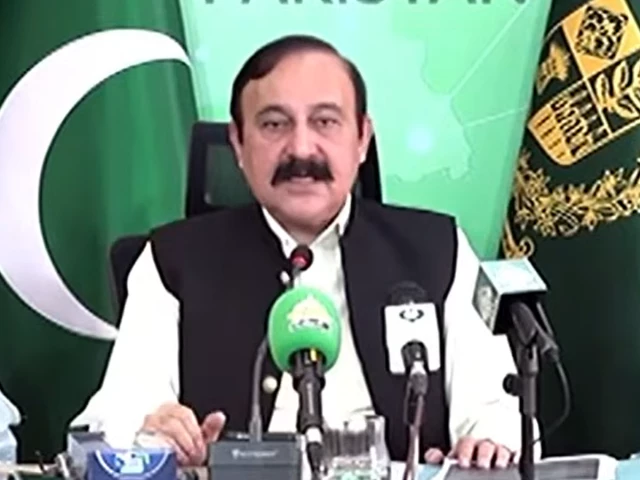
Federal Minister for Parliamentary Affairs Tariq Fazal Chaudhry. Photo: File
Parliamentary Affairs Minister Tariq Fazal Chaudhry said on Wednesday that the federal government was “seriously” considering the imposition of an emergency in Khyber Pakhtunkhwa (K-P) in response to the worsening security situation in the province.
Political uncertainty has deepened in K-P amid growing tensions between the federal and provincial governments, with the Centre considering governor’s rule and emergency as possible options.
Speaking to journalists at Parliament House, Chaudhry stated that the imposition of an emergency was being considered in K-P because of “increasing terrorism” and the provincial government’s lack of “interest” and failure to control the security situation. “The possibility of imposing an emergency under Article 232 of the Constitution is being discussed”.
Read: Centre lays ground for governor’s rule in K-P
While talking about consultations with the Pakistan Peoples Party on the imposition of emergency in K-P, Chaudhry said the National Assembly speaker would chair a meeting where matters related to legislation would also be discussed.
خیبر پختو نخوا میں ایمر جنسی کے نفاذ کی قیاس آرائیوں نے نئی بحث چھیڑ دی
Disclaimer: For news reporting and informational purposes only. Views or actions expressed by subjects do not imply endorsement by Express News .
Shared in the public interest in compliance with community… pic.twitter.com/DxU2AuuwPB— Express News (@ExpressNewsPK) September 30, 2026
He added that the federal government could take the PPP into confidence if it decided to proceed with the emergency. “Pakistan Peoples Party has always fought the war against terrorism with full commitment.”
The issue of Governor’s Rule has become a major point of contention between the federal and K-P government. On September 21, Interior Minister Mohsin Naqvi said the government was consulting the law ministry on legal options for the province, including Governor’s Rule, if the PTI proceeded with the march. Two days later, however, Information Minister Atta Tarar ruled out any plan to impose Governor’s Rule, saying the federal government had no intention of removing the PTI administration.
On Monday, some federal ministers publicly raised the possibility of federal intervention in K-P. Federal Minister for Kashmir Affairs Amir Muqam said consultations were under way on the “constitutional and legal option” of imposing Governors’ Rule.
Law Minister Azam Nazeer Tarar also said if constitutional conditions for such a step or an emergency were met, it could be implemented.
K-P Governor Faisal Karim Kundi separately warned the provincial government against creating a situation that could force the Centre to impose Governors’ Rule.
Earlier today, K-P Chief Minister Sohail Afridi warned that the PTI would “rebel” if necessary to force a change in the federal government policies that were “harming the province”.
Read More: Afridi threatens revolt to ‘force change’
Afridi, however, rejected the warnings and said he would not retreat from his position because of threats of Governors’ Rule or an emergency. He also said PTI supporters could take to the streets at short notice if an attempt was made to remove him.
The developments come amid continued tensions following PTI’s announcement of an Islamabad march. Although the protest was postponed from September 27 to October 4, the standoff between the federal and provincial governments remains unresolved.
Reports have also emerged about the possible disqualification of the chief minister, his replacement, an in-house change, dissolution of the assembly and a no-confidence motion against him under Article 136 of the Constitution.
The no-confidence motion can be submitted to the assembly secretariat with signatures of 20% of the total membership, following which an assembly session is to be convened within three to seven days on a single-point agenda.
The assembly rules lay down the procedure for a no-confidence motion. After the motion is moved in the house, voting is held through a secret ballot, with members expressing their choice in two separate lobbies. If the motion succeeds, the speaker will issue a schedule for the election of a new chief minister.
The Constitution also provides for the governor to require the chief minister to seek a vote of confidence under Article 130(7). If the governor believes the chief minister has lost the confidence of the majority in the house, the chief minister is required to demonstrate his numerical strength in the assembly.