Araghchi says contacts have become more serious since Tehran’s latest proposal, hopes for final US response Tuesday
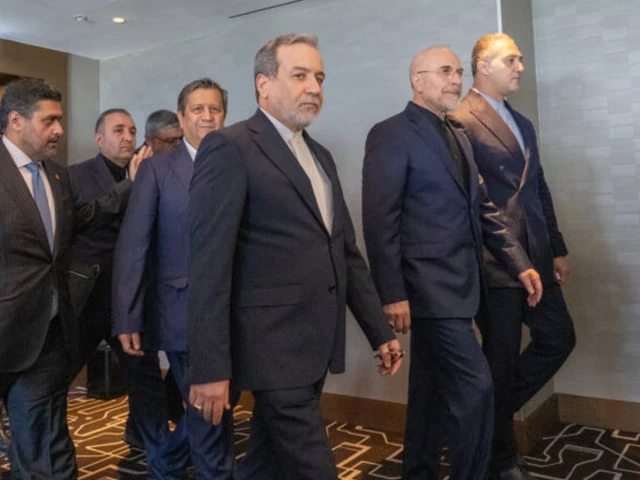
Iranian Foreign Minister Abbas Araghchi and Parliament Speaker Mohammad Bagher Ghalibaf in Switzerland. Photo: AFP
Qatari mediators will present the US with new ideas discussed with Tehran on how to meet Iran’s conditions for reopening the Strait of Hormuz, Iranian Foreign Minister Abbas Araghchi said late Monday, adding a final response from Washington could come Tuesday.
Speaking to Iranian reporters in New York, Araghchi said he met again with Qatari mediators and discussed possible ways to facilitate implementation of Tehran’s conditions.
Qatari mediators will present the US with new ideas discussed with Tehran on how to meet Iran’s conditions for reopening the Strait of Hormuz, Iranian Foreign Minister Abbas Araghchi says, adding that a final response from Washington could come Tuesday https://t.co/2On9DqE6YF pic.twitter.com/zDKH01O2Uu
— Anadolu English (@anadoluagency) September 28, 2026
“They had ideas, and we discussed how a way could be found to meet Iran’s conditions and how those conditions could be fulfilled,” he said, according to the official IRNA news agency.
The ideas will now be raised with the US side, after which Washington’s final response will be relayed to Tehran, Araghchi said.
Read: Trump says US officials talked with mediators, will win Iran war ‘very soon’
“I hope this will happen by tomorrow,” he added.
Araghchi said he would leave New York for Tehran within hours and that the Qatari mediators would relay the US response once it was available.
He said exchanges through Qatari and Pakistani mediators had remained open but had become more serious following Iran’s latest proposal.
Araghchi said Tehran had also used its meetings in New York to convey to Washington and the international community the conditions it says must be met for the Strait of Hormuz to reopen.
US, Iran separately talk with mediators in latest bid to end war
US and Iranian officials spoke separately with mediators on Monday as part of a renewed effort to end seven months of war, according to officials of both countries.
Any further talks are expected to focus on an amended version of a seven-day proposal that Iran presented last week on the sidelines of the United Nations General Assembly, an official briefed on the negotiations told Reuters.
The war began in late February with US and Israeli attacks on Iran, killing thousands of people over seven months and shocking global markets as vital waterways for oil remained choked. The US and Iran have twice previously agreed to ceasefires in mediated peace talks, in April and June. Those agreements quickly unravelled.
Read more: Iran Guards claim seizure of US underwater drone in Hormuz, US denies
Araghchi, who remained in New York after attending the General Assembly, said Iran expected to receive the US response to its latest ceasefire proposals and its conditions for restoring passage of maritime traffic in the Strait of Hormuz, according to state news agency IRNA.
“If the Americans claim they are seeking an agreement or a peaceful solution, we have presented that solution,” Araghchi said.
US officials separately spoke with mediators on Monday, US President Donald Trump told reporters at the White House, without giving further details.
Trump flags further talks this week
Iran’s seven-day plan envisages an end to all hostilities in Iran and Lebanon, the unfreezing of billions of dollars’ worth of Iranian assets, an end to sanctions on Iranian oil and the lifting of the US blockade on Iranian ports.
Iran would then allow the reopening of the Strait of Hormuz, a vital conduit for oil tankers, and the two sides would also resume talks on Iran’s nuclear program and Trump’s wish to seize or eliminate its highly enriched uranium.
Trump said on Saturday he had rejected Iran’s proposal, saying Iran wanted a swift agreement because of the crippling economic pressure it is under. However, he also told Axios on Sunday that he expected US negotiators to engage in further talks this week.
Also read: At UNGA, Iran’s president vows ‘no surrender to US’
Araghchi said on Sunday that mediators had not formally conveyed a US rejection, and that Iran was awaiting Washington’s definitive position before deciding its next steps.
“Our conditions are clear, and any move toward reopening the Strait of Hormuz is contingent on these conditions being met,” he said on Sunday, adding that only a negotiated solution could resolve the impasse.
US to grant sanctions waiver for flights between Iran and Iraq’s Najaf, source says
US President Donald Trump’s administration was set to grant a limited waiver to its Iran sanctions program on Monday to allow for flights carrying Shi’ite Muslim religious pilgrims between Iran and Iraq, a person with direct knowledge of the matter said.
The source, who is involved in the deliberations, said the US Treasury Department waiver would allow Iraqi Airways to fly back and forth between Iran and the Shi’ite holy city of Najaf in Iraq for one month, with a more permanent waiver potentially following.
Iraq halted flights to and from Iran on Friday, in line with US sanctions.
The source said the move aimed to ease pressure on the Iraqi government of Prime Minister Ali al-Zaidi, who has sought to deepen ties with Washington while also balancing a strong relationship with Iraq’s influential neighbour, Iran.
Trump’s effort to impose a crippling economic blockade on Iran is forcing regional governments to scale back ties with Iran, creating potential backlash against those states, particularly those that balance their ties with both Washington and Tehran.
Zaidi’s office over the weekend said that Iraq was seeking an exemption for travel between Iran and Iraq for medical treatment, education and pilgrimage.
An Iraqi official said the Iraqi government was in talks with the US about the Najaf exemption and expected flights between Iran and Najaf to resume within 48 hours.
The US State Department referred questions to the Treasury Department, which did not immediately respond to a request for comment.
In recent days, countries including Turkey, the UAE and Iraq have cancelled direct flights with Iran as a result of US pressure. In response, Iranian officials have threatened to halt regional air travel if Iran’s air links continued to be cut.
With religious pilgrims travelling between Iran and Iraq each year to visit key shrine cities, Iraq is perhaps in the most sensitive position.
Najaf, a centre for religious study, draws millions of pilgrims a year to the shrine of Imam Ali, the first Shi’ite leader, and the world’s largest and oldest active Islamic cemetery.
The source said that barring flights between the two countries could cause severe backlash against Iraq’s government by uniting Shi’ites who follow Iran’s supreme leader and those who follow Iraq’s Grand Ayatollah Ali al-Sistani, undermining US efforts to reduce Iranian influence in Iraq.
Zaidi has offered safeguards for the flights, including rigorous screening and information sharing, and ensuring the flights are not used to transfer weapons, sanctioned individuals, or illicit money, the source said.
Trump denies offering Iran sanctions relief, release of frozen assets
President Donald Trump denied an Axios report stating that he offered Iran sanctions relief and the release of frozen funds, according to a post he made on his Truth Social account.
“Axios just released a story that ‘Trump’ offered sanctions relief and frozen funds to Iran. This is untrue. I offered them NOTHING!,” Trump said.
“They should withdraw this fake story, IMMEDIATELY!”