Iranian President hails Pakistan’s peace efforts, discusses regional tensions and ways to deepen cooperation
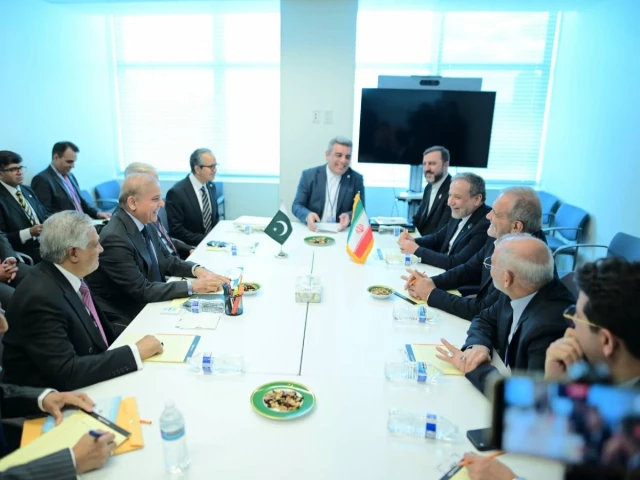
Prime Minister Shehbaz Sharif and Iranian President Masoud Pezeshkian lead their respective delegations during a meeting on the sidelines of the 81st UNGA session in New York on Thursday. Photo: X/ PMO
Prime Minister Shehbaz Sharif on Thursday said Iranian President Masoud Pezeshkian had hailed Pakistan’s efforts for peace in the region and conveyed that the Islamabad Memorandum of Understanding (MoU) remained fully acceptable to Iran.
The prime minister was speaking to media representatives alongside his Lebanese counterpart Nawaf Salam after he met with the Iranian president on the sidelines of the United Nations General Assembly in New York.
Asked about the Islamabad MoU, under which Pakistan had mediated between Iran and the United States, the prime minister said Pakistan’s entire leadership was united in its resolve to further accelerate efforts for peace under the memorandum.
Read More: US and Iran discuss phased deal to reopen Hormuz and end US blockade, sources say
The premier also expressed particular concern over the situation in the Strait of Hormuz and the Red Sea, saying brotherly and friendly countries were making efforts to reduce the tensions there.
He said he had also discussed the issue with the Iranian president during their meeting and told him that establishing peace in the region was an urgent need of the hour and that Pakistan would, as before, play its role in this regard.
PM Shehbaz said President Pezeshkian had appreciated Pakistan’s efforts and said the Islamabad MoU was still fully acceptable to Iran and that Tehran was ready to take it forward.
Shehbaz condemned the continued atrocities against Lebanon, calling them unacceptable. “Pakistan and Lebanon would work together to promote peace in the region jointly,” he said.
PM Shehbaz reaffirms readiness to play ‘constructive role’ for regional peace
Earlier, PM Shehbaz reaffirmed Pakistan’s readiness to continue playing a “sincere and constructive role” in support of regional peace during a meeting with Iranian President Masoud Pezeshkian on the sidelines of the 81st session of the United Nations General Assembly in New York.
The meeting took place a day before the premier is scheduled to address the UN General Assembly on Friday.
According to a statement issued by the Prime Minister’s Office, the two leaders reaffirmed the close and longstanding ties between Pakistan and Iran and underscored the need to further strengthen bilateral cooperation across all areas of mutual interest.
Prime Minister Muhammad Shehbaz Sharif met with the President of Islamic Republic of Iran, H.E. Dr. Masoud Pezeshkian today, on the sidelines of the 81st Session of United Nations General Assembly (UNGA) in New York.
Deputy Prime Minister/Foreign Minister Senator Mohammad Ishaq… pic.twitter.com/BHkCwC2QNI
— Prime Minister’s Office (@PakPMO) September 24, 2026
“Both leaders also exchanged views on the evolving regional situation,” the statement said.
The prime minister expressed deep concern over the prolonged conflict and emphasised the need for restraint, de-escalation and sustained diplomatic engagement to achieve lasting peace and stability in the region.
PM Shehbaz reaffirmed Pakistan’s readiness to continue playing a sincere and constructive role in support of regional peace and stability, while underscoring the importance of building on and implementing the Islamabad Memorandum of Understanding.
“President Pezeshkian appreciated Pakistan’s principled diplomacy and concerted efforts for regional peace and security,” the statement said.
The Iranian president also underscored the enduring strength of Pakistan-Iran relations, rooted in shared history, culture and faith, and reaffirmed Tehran’s strong desire to further deepen multifaceted cooperation.
The two sides agreed to work for regional peace, security and prosperity, while underlining the importance of maintaining regular consultations and close coordination to address prevailing challenges and seize opportunities, the statement added.
Deputy Prime Minister and Foreign Minister Senator Mohammad Ishaq Dar, Defence Minister Khawaja Muhammad Asif, SAPM Tariq Fatemi and senior officials from both sides were also present.
The prime minister later, in a post on X, said he had an “important exchange” on the evolving regional situation.
“I reiterated Pakistan’s deep concern over the prolonged conflict and stressed the urgent need for restraint, de-escalation and sustained diplomacy. We remain committed to building on the Islamabad Memorandum of Understanding and will continue to play a sincere and constructive role in the pursuit of lasting peace and stability in the region.”
It was a pleasure to meet my dear brother, President Dr. Masoud Pezeshkian, in New York today on the sidelines of UNGA.
We reaffirmed the deep and longstanding bonds between Pakistan and Iran and our shared desire to further strengthen bilateral cooperation across all areas of… pic.twitter.com/MB0DkERKVj
— Shehbaz Sharif (@CMShehbaz) September 24, 2026
Pakistan has already made several mediation attempts during the seven-month-old conflict. Islamabad hosted indirect contacts between the United States and Iran and has continued to argue that the dispute cannot be resolved through military means.
Those efforts have gained urgency as the conflict has begun affecting both major maritime energy routes in the region. Shipping through the Strait of Hormuz remains severely reduced, while the security situation around Bab el-Mandeb has also deteriorated.
The strait has become the central bargaining chip in efforts to end the nearly seven-month US-Iran conflict, with Iran seeking relief from the US blockade that is choking its economy and Washington seeking free passage for ships on the global oil supply route now blocked by Tehran.
The latest escalation has also pushed up global energy prices and increased pressure on Gulf states to find a diplomatic way out.
Meanwhile, Washington and Tehran remain far from resolving their differences. US President Donald Trump has said he hopes the war with Iran is nearing an end, but negotiations remain stalled.
The talks face a big obstacle as neither side wants to be the first to surrender its leverage, according to comments to Reuters by two Iranian sources, two regional officials and two Western diplomatic sources, but behind Iran’s stance is a recognition of the economic cost of prolonged confrontation.
A deal before the midterms could benefit Trump, as reopening Hormuz could ease tensions in the Gulf, contain oil prices and help bring down politically sensitive US gasoline prices.
Iran’s chances of gaining much-needed economic relief may be greater while Trump still has a greater political incentive to strike a bargain.
However, former US negotiator Dennis Ross said he saw only a 30% chance of an agreement being reached before the vote, but that both sides may have stronger reasons to make a deal before than after the midterms.
After the midterms, Ross said, Trump may face fewer constraints and be more willing to intensify pressure or consider military options.