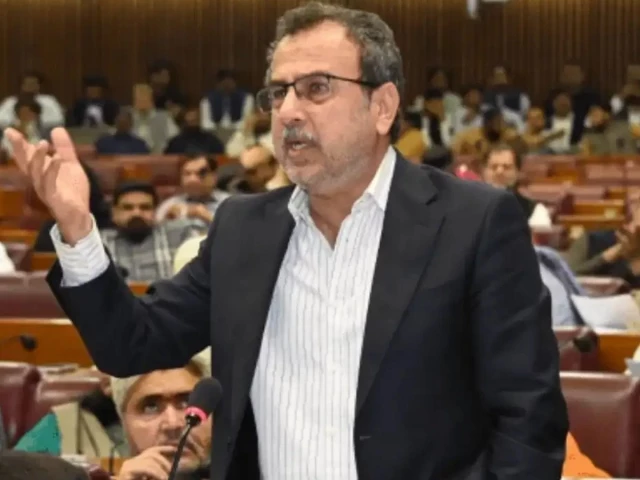
Power Minister Awais Leghari. Photo: File
ISLAMABAD:
Federal Minister for Energy Awais Leghari has blamed distribution companies (DISCOs) and their staff for a large part of the country’s load shedding, admitting that thousands of feeders are facing outages because of electricity theft and line losses.
Briefing the National Assembly Standing Committee on Power, which met under the chairmanship of Muhammad Idris on Wednesday, Leghari said the country had around 14,000 feeders, of which approximately 3,500 were experiencing load shedding because of theft and line losses.
He said DISCOs were carrying out several hundred times more load shedding than they were officially allowed to undertake. He also disclosed that the power distribution system had become overloaded and required extensive investment to address its infrastructure problems.
“We need Rs600 million to Rs1 billion in every constituency to fix the electricity system,” he said.
He said a comprehensive investment programme had been ordered for DISCOs to improve infrastructure. The total investment required for the power system would be around Rs200 billion, which would be recovered from consumers over a period of 25 years.
According to the minister, the recovery would not place a significant additional burden on consumers, while the investment would allow the distribution system to be upgraded.
Leghari acknowledged that adequate investment had not been made in the DISCO systems so far.
He said the government had prepared a plan on the directions of the prime minister for improving the performance of the distribution companies. The minister also revealed that manipulation of sanctioned loads in demand notices was contributing to overloading of the power system.
He alleged that consumers sometimes got their loads understated in demand notices through collusion with electricity staff, including line-men and sub-divisional officers, after paying bribes.
“Electricity staff take bribes and even eat chickens to get the load written lower, which is ruining the system,” he said, adding that such practices ultimately placed excessive loads on the distribution network because the infrastructure was not designed to meet actual consumption requirements.
He said the government was also changing its approach to load shedding by moving from feeder-level outages to transformer-level outages.
He said after the new system was implemented, electricity would be shut off only at the transformer where theft was taking place rather than cutting power to an entire feeder.
He said the new system for switching transformers on and off was a concept being used internationally. He said the regulatory framework for the new system would be provided by April or May next year.
Leghari said the government was not carrying out any additional load shedding in the country beyond what was permitted. He explained the government’s decision to avoid operating gas-fired power plants during peak hours, saying load shedding during peak hours had been carried out to save fuel costs.
“The gas cargo that used to cost $30 million has now increased to more than $95 million,” he said.
During the meeting, committee member Rana Muhammad Hayat told the minister that despite extensive discussion about reforms, electricity had not become cheaper.
Leghari rejected the criticism and asked him to prove that electricity had become more expensive. “You are making irresponsible statements before a responsible forum,” the minister alleged.
The minister also said the country had entered an era of rapid growth in battery use, particularly following changes to the net-metering system. He said it was in consumers’ interest to use electricity at night and disclosed that DISCOs had been directed to facilitate the installation of battery systems.
Leghari also denied reports that the government had signed new agreements with any independent power producers (IPPs), saying incorrect reports had appeared in the media. “Changes in the energy system, including greater use of batteries, will help reduce pressure on the national grid,” he said.
He said the government had also taken steps to prevent the burden associated with electricity consumption by a relatively small number of consumers from being shifted to the wider consumer base.