Alleged that govt has used force against unarmed protesters, says people expect state to treat them ‘like a mother’
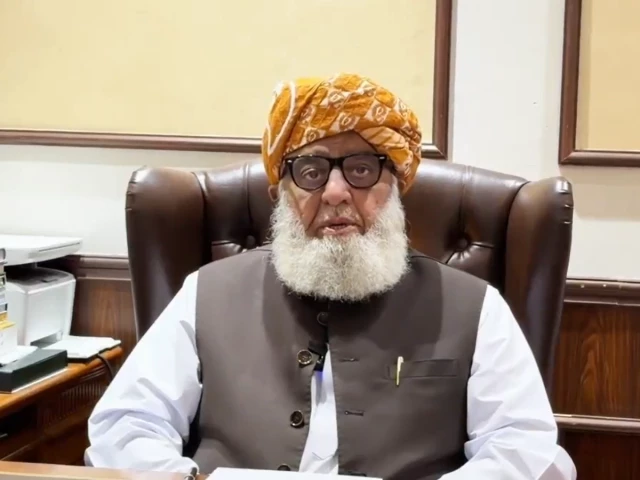
Jamiat Ulema-e-Islam-Fazl (JUI-F) chief Maulana Fazlur Rehman speaking in a video message. SCREENGRAB
Jamiat Ulema-e-Islam-Fazl (JUI-F) chief Maulana Fazlur Rehman on Saturday urged the government to recognise the gravity of the protests in Azad Jammu and Kashmir (AJK) and pursue reconciliation to resolve the issue.
“The government must realise the seriousness of the situation. Our state institutions and state authorities must also recognise it. Instead of staining our home with blood, they should strive to make it flourish. I appeal to them to seriously consider our request, pursue reconciliation and move forward towards resolving the issue,” Fazl said in a video message posted on the party’s X account.
The statement came after clashes were reported between law enforcement personnel and the proscribed JAAC protesters in Rawalakot, with reports of multiple deaths and injuries circulating on social media. Both security forces and the JAAC claimed the loss of lives.
Fazl said the JAAC’s sit-in had continued for more than two months and recalled that after tensions escalated on June 5, the committee had approached him in writing to act as a mediator between the protesters and the government.
He said the committee had placed its trust in him and he accepted the request, maintaining contact through JUI-F AJK chief Maulana Saeed Yousaf Khan and Sardar Kamran Azam Khan.
According to Fazl, while the committee showed confidence in his mediation efforts, the government did not give them due importance and remained unwilling to pursue a political solution, instead insisting on suppressing the movement through force.
اسلام آباد:امیر جےیوآئی مولانا فضل الرحمان کا اہم ویڈیو پیغام، یکم اگست 2026
کشمیر عوامی ایکشن کمیٹی کی زیرِ قیادت اہلِ کشمیر کا احتجاج جاری ہے۔ دو ماہ سے زیادہ عرصہ ہو گیا ہے، وہ دھرنا دیے بیٹھے ہیں۔ اس حوالے سے 5 جون 2026ء کو جب حالات خراب ہوئے، کشیدگی بڑھ گئی، حکومت اور کمیٹی… pic.twitter.com/cmXanO1uLL
— Jamiat Ulama-e-Islam Pakistan (@juipakofficial) July 31, 2026

Fazl said people expected their government and the state to treat them “like a mother”, but instead had lived under constant fear. “Mothers, sisters and children have been living in fear day and night, yet the rulers have shown no concern,” he said.
He alleged that the government had used force against unarmed protesters, claiming that “to the best of my knowledge, the number of martyrs has reached 80”, and accused the authorities of showing no mercy towards the people of AJK.
Despite the violence, the JUI-F chief urged the JAAC to remain patient. “I appeal to them… to give more time for a solution, refrain from taking any major step and give another opportunity for a just and lasting settlement to emerge,” he said, praising the protesters for their restraint and the trust they had placed in him.
Read: AJK assembly passes resolution seeking truth commission into recent unrest
Fazl warned that the movement had spread across Kashmir and was drawing support in other parts of Pakistan and among the Kashmiri diaspora, particularly in Europe.
Clashes in AJK
The clashes in AJK have drawn widespread condemnation from political parties and rights groups following reports of deaths and injuries during protests.
The Human Rights Commission of Pakistan stated that it was “deeply alarmed” by the reports, emphasising that maintaining public order “must never come at the expense of the right to life or the freedoms of peaceful assembly and expression”. It called for a “prompt, impartial and independent investigation” into the reported deaths and injuries.
Opposition parties also condemned the violence. PTI demanded an “immediate, independent, transparent and impartial judicial investigation”, describing the reported deaths and injuries as an attack on “human rights, democratic values and civil liberties.”
TTAP denounced what it called the use of “excessive force” against protesters, while JUI-F chief described the firing on civilians as “open terrorism”.
Read More: Viral Kashmir visuals. One media blackout: what an investigation found
AJK’s 53-member legislative assembly includes 12 seats reserved for Kashmiri refugees — people who fled Indian Illegally Occupied Jammu and Kashmir (IIOJK) in 1947 and 1965 and are now scattered across Pakistan. Six seats represent refugees from the Jammu division (~434,000 people) and six from the Kashmir Valley (~30,000 people) — an already lopsided arrangement that many see as unfair.
The region witnessed one of its most turbulent periods in October last year when protests led by the JAAC erupted over demands for constitutional and governance reforms. At least nine people, including three policemen, were killed during the unrest.
The JAAC, which organised the protests and strike, had presented a wide-ranging charter of demands, including an end to the privileges enjoyed by the ruling elite, the abolition of 12 assembly seats reserved for refugees, and the scrapping of the quota system.
Two days after the violence, the government and the JAAC reached an agreement covering 12 core and 13 additional points. Under the accord, both sides agreed to constitute a high-level committee to examine the issue of refugee seats in the AJK Legislative Assembly.
The matter is at a deadlock at the moment, with the JAAC calling for the abolition of the seats while the government rejects the demand.