
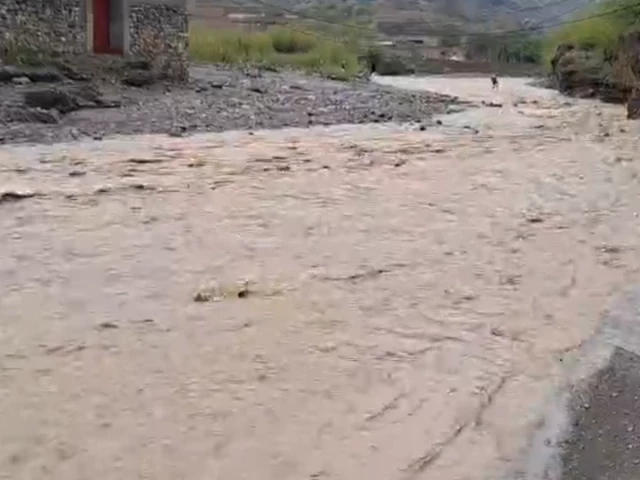
Heavy rainfall has continued across Khyber Pakhtunkhwa since Monday night, causing widespread disruption and flooding. PHOTO: EXPRESS
ISLAMABAD:
As the monsoon intensified, heavy rains on Thursday lashed the country’s upper and northern regions, causing widespread disruption.
Lahore recorded 343 millimetres of rainfall over the past 48 hours, while Gilgit-Baltistan bore the brunt of torrential downpours over the past two days. The region was further battered by cloudbursts, rapid glacial melting, and severe flooding in streams and rivers, exacerbating the impact of the extreme weather.
Moreover, the Flood Forecasting Division of the Pakistan Meteorological Department warned of rising flood risks as a strong monsoon system interacting with a westerly wave is expected to trigger widespread rainfall, rapid river inflows, flash floods in mountainous areas, hill torrents and urban flooding in vulnerable cities, prompting authorities to monitor river catchments and disaster-prone regions closely.
According to a hydrological situation alert, widespread rain with isolated heavy falls is expected over Gilgit-Baltistan, Khyber-Pakhtunkhwa, Azad Jammu and Kashmir, Punjab and parts of Balochistan during the next two days.
High flood conditions persisted at the Khanki and Qadirabad barrages on the River Chenab on Thursday, while Marala Barrage remained at medium flood level as monsoon flows continued to swell Punjab’s rivers, the latest data showed.
The data showed the Chenab at Marala Barrage recorded an inflow of 194,452 cusecs and an outflow of 174,452 cusecs, maintaining a medium flood level. At Khanki Barrage, inflow reached 261,463 cusecs against an outflow of 256,063 cusecs, placing the barrage in a high flood category.
At Qadirabad Barrage, the river carried an inflow of 267,159 cusecs, while 252,159 cusecs were discharged downstream. Authorities said 15,000 cusecs of water were being diverted into the Q-B Link Canal, while high flood conditions continued at the barrage.
The Ravi River remained largely stable. At Kot Naina, the river was flowing at 17,500 cusecs, with water levels showing a declining trend. Flows at Jassar, Ravi Siphon and Shahdara were recorded at 24,940 cusecs, 32,577 cusecs and 32,138 cusecs, respectively, with conditions described as normal.
Gilgit-Baltistan
Flood torrents, landslides and falling debris have severely damaged numerous houses, link roads, three major bridges, irrigation systems, drinking water schemes and large areas of agricultural land, while ground connectivity to several areas has been cut off.
The Gilgit-Chitral Expressway has also been closed due to the rains.
On the outskirts of Gilgit city, floodwaters entered homes in Konodas, Skarkoi, Jotal and Naltar causing heavy damage to standing crops and trees.
Khyber-Pakhtunkhwa
At least 22 people have been killed and 23 others injured in northwestern Khyber Pakhtunkhwa province since July 19 as heavy monsoon rains and flash floods triggered house collapses and swept away people, the Provincial Disaster Management Authority (PDMA) said on Thursday.