
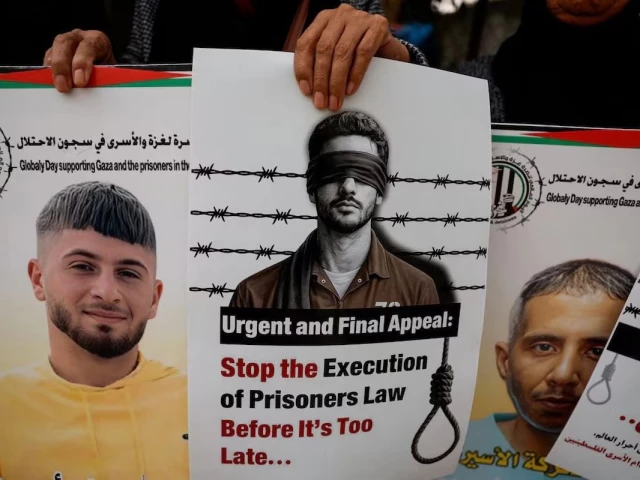
Palestinians hold placards as they take part in a protest against the execution of the Israeli death penalty law for Palestinians convicted of lethal attacks, in Ramallah in the Israeli-occupied West Bank, March 31, 2026.PHOTO: REUTERS
Palestinians in the occupied West Bank voiced fears on Tuesday that their jailed relatives could be hanged without due process after Israel adopted a new law making the death penalty the default sentence for Palestinians convicted of lethal attacks.
The law would also apply to Israeli citizens, but by defining the lethal attacks in question as those “negating Israel’s existence”, it would be very unlikely that it would be used against Jewish Israelis, critics say.
The law, which was passed late on Monday, is expected to be struck down by Israel’s Supreme Court following an appeal by rights groups as it has elements in breach of an international convention, Israeli legal experts said, adding it is unlikely that any executions will actually be carried out.
The UN rights chief on Tuesday said the legislation violated international humanitarian law.
Military courts have 96% conviction rate
The law mandates execution specifically by hanging, a provision experts said was included over concerns Israeli doctors would refuse to conduct lethal injections. It would generally require execution within 90 days of sentencing, with no right to clemency.
The law provides judges the option to choose life imprisonment over capital punishment, but only in unspecified “special circumstances”.
Israeli rights group B’Tselem says military courts in the West Bank, where only cases involving Palestinians are heard, have a 96% conviction rate and a history of extracting confessions under duress or even through torture. Israel denies this.
In the West Bank city of Ramallah, the families of Palestinian prisoners held a protest on Tuesday, where they called for the death penalty law to be repealed.
“I am afraid for my son and for all the prisoners. The news came down like a thunderbolt on the prisoners’ families,” said Maysoun Shawamreh, whose son, 29-year-old Mansour, has been imprisoned on attempted murder charges.
Abdel Fattah al-Himouni’s son, Ahmed, is in prison awaiting trial over a combined shooting and stabbing attack at a light-rail stop near Tel Aviv in October 2024. That attack killed seven people, including a woman who was clutching her baby.
He fears his son will now face the death penalty, if convicted, and voiced scepticism that he would face a fair trial.
“I appeal to human rights organisations to pressure the Israeli government so this law does not come into effect,” said al-Himouni.
Supreme court likely to strike down law, experts law
The Fourth Geneva Convention of 1949, which Israel has ratified, says that persons condemned to death cannot be deprived of the right of petition for pardon and lays down a minimum of six months between sentence and execution.
Read More: Israel passes law mandating death penalty for Palestinian prisoners
Mordechai Kremnitzer, a law professor with the Israel Democracy Institute, said the law is “a clear case that invites the Supreme Court to strike it down.”
“The likelihood of executions in the near future is not very high,” Kremnitzer said. Judges are likely to show a negative attitude towards capital punishment because it runs against both universal morality and Jewish morality, he added.
Settler violence
The legislation has drawn international criticism of Israel, which is already under scrutiny for increasing violence by settlers against Palestinians in the West Bank and for its conduct of the war against Hamas in Gaza.
Israeli settlers’ frequent attacks on Palestinians in the West Bank rarely end in military court indictments. Israeli monitoring organisation Yesh Din said the last case they had recorded of an Israeli citizen indicted for killing a Palestinian was from an attack in 2018.
In Israel’s civilian courts, where Palestinians can also face trial, the law would also impose death or life imprisonment for homicide with the intention of “negating Israel’s existence”, a description unlikely to apply to a Jewish defendant.
“That’s how the law will only apply to Palestinians,” said attorney Debbie Gild-Hayo, of The Association for Civil Rights in Israel, which petitioned the Supreme Court over the measure.
Suhad Bishara, whose rights group Adalah co-wrote the appeal with ACRI, said that “military courts have no basic guarantees for a fair trial” and that Israel’s parliament did not have jurisdiction to legislate in occupied territory.
New law will not apply to October 7 attackers
Raed Abu al-Hummus, the Palestinian Authority’s minister for prisoners, estimated that 45 to 47 Palestinian detainees are awaiting sentencing on murder charges and may face the death sentence if the new law is implemented.
ACRI said that it would only apply to criminal acts of killing going forward, not retroactively.
It would also not apply to the hundreds of Hamas members who took part in the October 7, 2023, attack that killed 1,200 people in southern Israel, ACRI’s Gild-Hayo said, because the Israeli parliament is still working on legislation on the legal framework that will bring them to trial.
For Israel’s far-right, the new law was a victory, fulfilling a main 2022 election campaign pledge by National Security Minister Itamar Ben-Gvir.
His Jewish Power party argues that the death penalty will deter Palestinians from carrying out deadly attacks against Israelis or attempting kidnappings to effect swap deals for Palestinians jailed in Israeli prisons.
Amnesty International, which tracks countries imposing death penalty laws, says there “is no evidence that the death penalty is any more effective in reducing crime than life imprisonment”.