US secretary of state’s speech effectively gave a quiet green light to modern-day colonisation
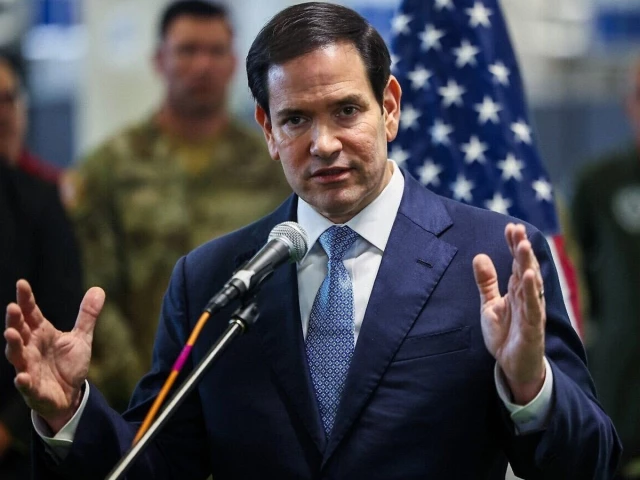
US Secretary of State Marco Rubio. Photo: File
KARACHI:
The Munich Security Conference has, over the years, developed an unintended reputation. It is not just a venue where policy is discussed, it is a stage on which great powers occasionally drop their diplomatic mask and reveal what they believe the structure of the world should look like.
In 2007, Vladimir Putin used that moment to warn that NATO’s steady expansion towards Russia’s borders would not be treated indefinitely as a technical matter of alliance management. Many in the hall heard irritation rather than strategy, dismissing it as routine bluster from the disgruntled Russian leader. The consequences of that misreading are now part of Europe’s daily news cycle — a war in Ukraine still raging, with no end in sight.
This year, Marco Rubio did something equally unsettling, though from the opposite side of the geopolitical divide. The US Secretary of State, like his boss, attempted to rewrite the moral story that has accompanied Western power since 1945.
What made the speech unsettling was not simply the words but the framing. Rubio did not argue for a specific intervention, treaty revision or security posture. He offered a historical narrative in which five centuries of Western expansion were presented as a civilisational project — missionaries, explorers, settlers carrying order, innovation and progress across the globe. Absent from that spiel were the structures that financed that expansion, such as forced labour, resource extraction, racial hierarchy, and the routine use of violence to suppress resistance. Critics argue it wasn’t just a choice of words — it was a political move. By painting the past as kind, the US Secretary of State made the present power structure look natural.
For decades, Washington has wielded immense power while talking the language of rules, alliances, and partnership — coercive in action, cooperative and polite in words. This duality allowed allies to align without appearing subordinate and gave smaller states a framework within which they could debate their positions and even bargain. Rubio’s speech narrowed that space, urging the West to shed what he called guilt and reassert authority across key regions, effectively signalling a willingness to abandon the moral cover that has long softened American power.
European allies now find themselves in an awkward spot, caught between promises of partnership and the ugly reality of hierarchy. The reception in the hall was almost as revealing as the speech itself. While applause does not equal endorsement, it did indicate that within parts of the Western policy community there is a growing tolerance for a more openly interest-driven framework — the very framework Rubio was advocating.
Outside the transatlantic space, experts believe the speech will be seen less as intellectual repositioning and more as a statement of intent — a practice now common among members of the Trump administration. Countries in Africa, Asia, and the Caribbean have spent decades diversifying economic and security ties to avoid overdependence on any single power. Talk of renewed Western authority will be read as a narrowing of that strategic space — effectively a quiet green light for modern-day colonisation.
The likely response is deeper engagement with alternative financial institutions, regional security arrangements, and non-Western technology networks, yet in trying to consolidate influence, the Trump administration may end up spreading power the very way it seeks to contain it. There’s also a systemic dimension that can’t be ignored — the post-1945 order, flawed as it was, set up rules, institutions, and consultation habits that helped manage rivalry among states, and an explicit shift toward a vocabulary of hierarchy, as Rubio’s speech suggests, risks weakening that order without offering any replacement.
This rhetoric probably won’t bring back formal colonial rule as it existed in the past, because today power runs through money, supply chains, tech standards, and security dependencies, rather than through excessive territorial control. The language still matters, because it sets the bounds of what’s seen as acceptable, and when a senior American official normalises the language of dominance, it lowers the diplomatic cost of coercive economic measures and conditional security arrangements, while signalling to allies that the decades-old fiction of equal partnership is becoming harder to sustain.
Munich, this year, therefore, was less about a concrete policy shift than a change in the moral vocabulary of Western power. If anything, Rubio’s speech suggested that Washington is ready to abandon the language of a rules-based order and speak more openly in terms of hierarchy, transactions, and competition.