Drone strikes hit Kuwait, Abu Dhabi plants; fires, damage reported, no casualties so far
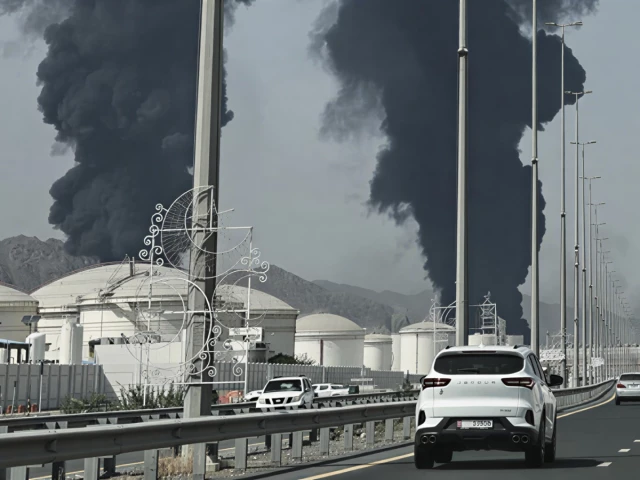
Smoke rises from the direction of an energy installation in the Gulf emirate of Fujairah on March 14, 2026. PHOTO: AFP
Iran’s Revolutionary Guards (IRGC) claimed responsibility on Sunday for attacks on petrochemical plants in the United Arab Emirates, Kuwait and Bahrain.
In a statement, the IRGC warned its attacks against US economic interests would be intensified if attacks on civilian targets in Iran are repeated.
Iran’s Revolutionary Guards said they had launched attacks on what they described as US economic interests in the region and Israeli energy infrastructure, following strikes on civilian sites in Iran.
In a statement, the Guards said the first phase of the response had targeted… pic.twitter.com/9oHrgdlN22
— Iran International English (@IranIntl_En) April 5, 2026
Both Kuwait and Abu Dhabi earlier reported damage and fire to their petrochemical installations.
Gulf News reported that the Kuwait Petroleum Company confirmed that several infrastructures were damaged in drone attacks from Iran. Notably, the Kuwait National Petroleum Company and Petrochemical Industries Company were damaged and caught fire.
No casualty was reported so far; however, the damage was reportedly “significant”. In response, the rescue and firefighting teams under the Kuwait Fire Force immediately took swift measures to contain the fire to other facilities.
The authorities were assessing the extent of the damage.
Gulf News also reported multiple fires at Abu Dhabi’s petrochemical plant after air defence interception in response to Iranian drone attacks. Authorities reported multiple fires at the Borouge petrochemical plant. Initial reports hinted that fallen debris sparked the fire after the successful interception of the attack.
Read More: Trump threatens Iran’s power plants in profanity-laced rant after costly pilot rescue operation
The National Emergency Crisis and Disaster Management Authority said the UAE was actively avoiding the missile and drone threat from Iran.
Air defense systems are currently responding to a missile threat. Please remain in a safe location and follow official channels for warnings and updates. pic.twitter.com/VwuJaCWjip
— NCEMA UAE (@NCEMAUAE) April 5, 2026
On February 28, the United States and Israel preemptively attacked Iran. Iran fired drones and missiles on Israel and US military bases and installations in the UAE, Saudi Arabia and other GCC countries.
Tehran also disrupted oil tankers at the Strait of Hormuz, an energy artery responsible for 20% and gas flow from the Gulf to other parts of the world.
The closure of Hormuz is causing a near standstill in commercial shipping and a surge in energy prices worldwide. Iran has also signalled plans to impose tolls or restrictions on vessels transiting the strait, leveraging its strategic position amid the conflict.
The disruption has heightened fears of a prolonged energy shock and broader regional instability, with global powers weighing military and diplomatic options to restore access to the key waterway.