With latest shipment of food items, ongoing humanitarian support to Palestine now totals over 2,800 tonnes of aid
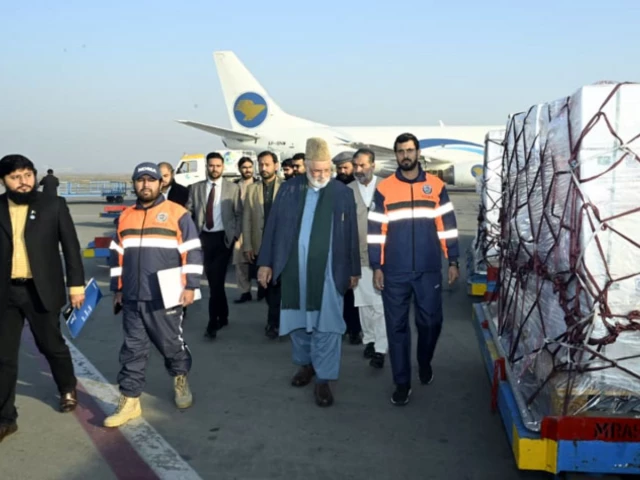
The sending-off ceremony was attended by senior officials from the NDMA, Ministry of Foreign Affairs along with representatives of other relevant government departments. PHOTO: RADIO PAKISTAN
Under the directives of Prime Minister Shehbaz Sharif, the National Disaster Management Authority (NDMA) has dispatched another consignment of humanitarian aid to Palestine.
The latest shipment, comprising 100 tonnes of food items including dates, flour, rice, and cooking oil, was sent via chartered flight from Allama Iqbal International Airport in Lahore to Egypt, for onward delivery to Gaza.
With the dispatch of this consignment, the total volume of humanitarian assistance sent to Palestine through 29 consignments now stands at 2,827 tonnes, according to Radio Pakistan.
The send-off ceremony was attended by senior officials from the NDMA, the Ministry of Foreign Affairs, and representatives from other relevant government departments. This aid consignment follows the 28th consignment of aid sent on Monday, which carried 100 tonnes of tents and tarpaulins.
Pakistan began sending humanitarian flights via Egypt soon after the conflict began in October 2023, when Hamas launched attacks on Israel on October 7, triggering Israel’s military campaign in Gaza. The first batch of humanitarian assistance left Islamabad for Egypt on October 19, 2023, for transfer onward to Gaza.
In January 2024, a Pakistani aircraft arrived at El-Arish carrying 20 tonnes, with the aid handed to the Egyptian Red Crescent Society for onward delivery to the Palestinian Red Crescent Society in Gaza.
A ceasefire agreement was signed in October 2025, aimed at halting fighting and addressing hostages and prisoners, though Israel has continuously violated and broken the ceasefire agreement, and throttled aid at tightly controlled routes.
The Gaza “Board of Peace”
The Board is a US-led international body created under a Trump‑backed plan to oversee Gaza’s temporary governance and implement a “Comprehensive Plan” aimed at ending the Israel‑Gaza conflict. According to details from the founding document, US President Donald Trump would chair the board indefinitely, and it would wield legislative, executive, and judicial authority over Gaza’s administration.
The structure includes an executive board empowered to enact or revise laws and a High Representative with broad powers over reconstruction, humanitarian aid, and governance. A Palestine advisory body is proposed but remains limited and subordinate to overall board control.
Under the plan, an International Stabilisation Force (ISF), initially led by US command, would help enforce security arrangements. While positioned as a framework linked to a UN Security Council resolution, many analysts and rights experts have said the structure resembles external control over Gaza’s affairs more than genuine local governance.
Pakistan accepted an invitation from the US to join the Board of Peace, with the foreign ministry framing the move as part of diplomatic efforts in support of peace in Gaza, humanitarian relief, reconstruction, and a pathway to an independent Palestinian state.
Prime Minister Shehbaz Sharif signed the document establishing Pakistan’s participation at the World Economic Forum in Davos. Government officials have emphasised that Pakistan’s involvement is limited to diplomacy, does not imply recognition of Israel, and allows Islamabad to remain relevant in future discussions on Gaza.
Despite joining, Pakistan does not have a seat on the executive board overseeing Gaza’s governance.
Opposition politicians criticised the government for signing up without consulting Parliament or the public. Voices like Jamiat Ulema‑e‑Islam-F chief and Maulana Fazlur Rehman accused the board of centralising control in the hands of those “who created the problem,” warning against reliance on Trump‑led mechanisms and decrying the sidelining of Palestinian agency.
Jamaat‑e‑Islami called Pakistan’s involvement “a new form of colonialism” and insisted the armed forces should never be involved in Gaza. Pakistan Tehreek‑e‑Insaf demanded transparency, publicising the board’s terms, and taking Parliament into confidence before making commitments.
After Israel signed on to join the board, rights experts warned that its structure, especially being chaired by Trump with broad authority over Gaza, resembles a “colonial” model of governance. Western countries have been cautious or stayed away from joining, raising questions about the board’s legitimacy and its potential to overshadow United Nations mechanisms.
The first official board meeting is scheduled for February 19 in Washington, where reconstruction plans and the board’s next steps are expected to be discussed.